
Leading Change in Higher Education: Lessons from the Work
By Amit Mrig, CEO, Academic Impressions

If you’ve been in higher education for any length of time, you know that change is hard. Not just hard in the generic, “people don’t like change” kind of way, but hard in the uniquely layered, deeply human way that’s particular to academic institutions.
In academia, we operate in systems with long memories, shared governance, decentralized decision-making, and deep commitments to individual autonomy. Over time, these structures have shaped cultures that favor continuity, protect professional expertise, and diffuse responsibility for change. While these dynamics have enabled much of higher education’s innovation and impact, they also make large-scale, coordinated change especially hard to lead.
And yet, we also know that the ground is shifting beneath us. Declining enrollment, increased public scrutiny, rapid technological change, demographic shifts, and evolving student needs are reshaping the landscape faster than many campuses can adapt. We are being asked to do more, to do it faster, and to do it with fewer resources.
In this environment, leading change isn’t just a technical challenge, it’s a deeply human one.
Why Most Change Efforts Fail in Higher Education
I’ve seen countless change efforts in higher education launch with urgency and fanfare, only to stall out. Sometimes they collapse quickly and publicly; more often, they fade quietly, with meetings and updates become less frequent until no one hears anything at all. Often, the final blow comes when the originating leader leaves. These failures erode belief that meaningful change is possible and instead embolden those opposed to it—who learn that they can simply wait it out until the next initiative disappears.
Leaders often assume that these failures stem from poor execution or a lack of urgency. In reality, however, the reasons are more complex.
Leaders often assume that these failures stem from poor execution or a lack of urgency. In reality, however, the reasons are more complex. Most change models—even popular ones like John Kotter’s 8 Steps to Leading Change—don’t factor in two critical dimensions: leadership capacity and organizational culture. Instead, they offer a set of universal steps that anyone can follow in any environment, yet they overlook the human factors of self-awareness, engagement, ego, loss, trust and psychological safety, and so much more.
Leadership capacity: Before leading change, leaders must first understand their own orientation toward it. Just because you’re in a leadership role doesn’t mean you are more naturally inclined towards change or know how to lead it. Research shows that most people resist change, but for different reasons. None are inherently better or worse—what matters is self-awareness. Leaders need clarity about how they respond to uncertainty, how they make decisions, and how they prefer to engage others in ideation and implementation.
A leader’s individual capacity to guide change is necessary, but not enough. Real progress requires dozens of people actively contributing to the creation and execution of new ideas. Change by definition involves doing something untested, which means that leaders must also build their teams’ capacity to think and act differently. Too often, however, leaders ask for innovation and new results from people and systems that are designed to produce the old ones.
Organizational culture: Change is difficult even under ideal conditions where trust is strong and resources are abundant. Unfortunately, that doesn’t describe most colleges and universities I visit today. When I travel to campuses, it’s all too common for me to see institutions with interim leaders at every level, with declining enrollments, budgets on the chopping block, and where fear and anxiety are running high. The result? Trust between senior and mid-level leaders is eroding, morale is low, and faculty and staff often feel disengaged or burned out.
This kind of environment is not one where innovation and new thinking can flourish. When trust breaks down, people turn inward. They prioritize protecting themselves over advancing the mission. Risk-taking declines, new ideas stall, and individuals stay narrowly focused on their immediate responsibilities—no more, no less.
I’m not suggesting that limited leadership capacity or a toxic culture makes change impossible. In fact, these are often the very environments where change is most urgently needed.
What matters is designing a change process that centers the human elements and does two things at once, that (1) builds leaders’ capacity to guide others through ambiguity and resistance, and (2) creates the cultural conditions defined by strong trust, high psychological safety, and shared ownership where new ideas can take root.
Grounded in research and years of on-the-ground work with colleges and universities, these ideas are intentionally incomplete. They do not attempt to account for every force shaping change—from institutional structures and incentives to external pressures (among many others).
I offer this piece and my experience in the hope that it can sharpen judgment, not replace it. That’s why I’m using the concept of lenses instead of a set of sequenced steps or a framework that connotes completeness. There are no silver bullets nor a set of prescribed steps that will guarantee success with a change effort.
A lens is about what you see, not what you do. Think of these considerations as places to look, as questions to ask and tensions to manage rather than boxes to check. As Ron Heifetz says, leaders need to be able to continually step onto the balcony to gain perspective—to ask what’s working and what’s not. Sometimes the action needed is reflection and evaluation, not pushing forward or reacting to the loudest voice.
No single lens is sufficient, however, and leaders need to shift focus as conditions change. As you review these considerations, you may recognize strength in some areas and weakness in others. That’s completely normal. Your ability to effect change isn’t binary, where everything either works perfectly or doesn’t work at all.
Because we’re focused on the human elements of change, these are not static dimensions but are instead dynamic parts of a whole. The key is to intentionally design a process to strengthen leadership capacity, build organizational capacity, and move the work forward.
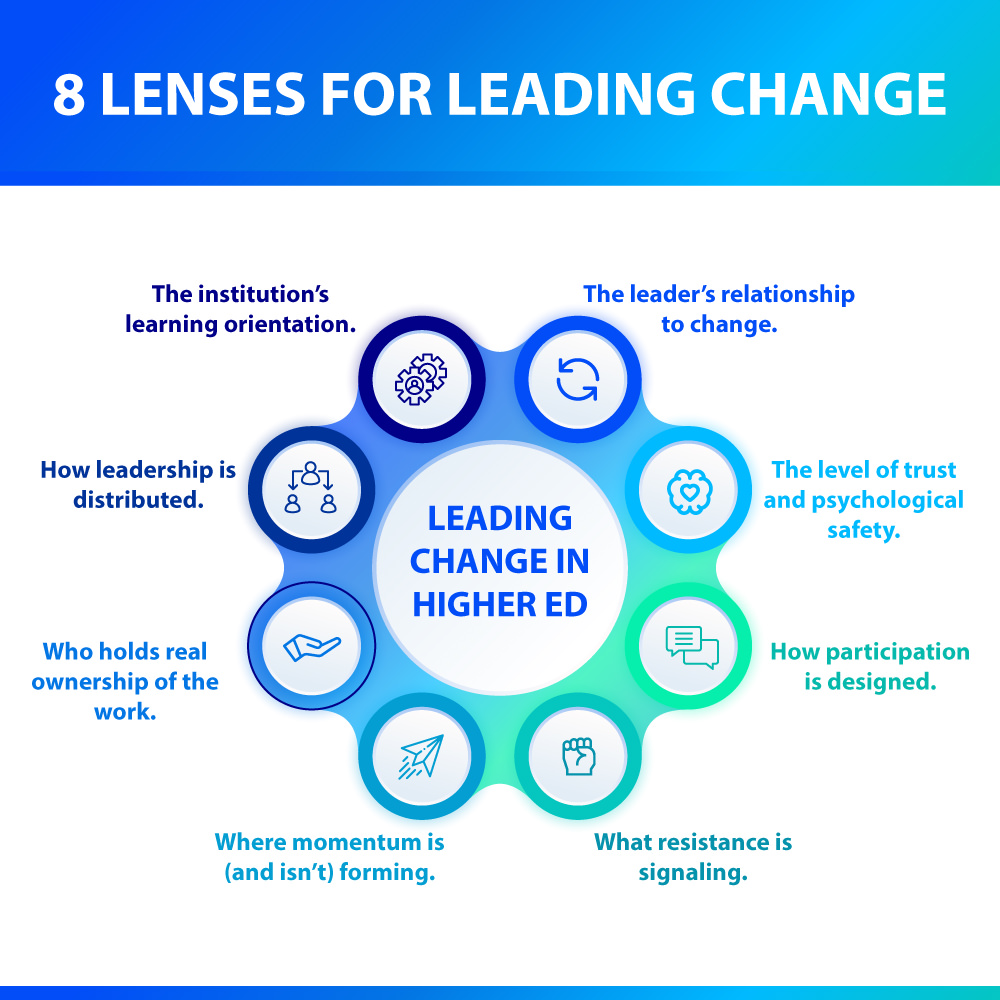
The eight lenses examine your change effort through:
- The leader’s relationship to change.
- The level of trust and psychological safety.
- How participation is designed.
- What resistance is signaling.
- Where momentum is (and isn’t) forming.
- Who holds real ownership of the work.
- How leadership is distributed.
- The institution’s learning orientation.
The Leader’s Relationship to Change
This may surprise you, but the most important place to begin a change initiative is not with your vision, your strategic plan, or even your team. It is with you.
Before you convene a committee or draft an email to campus, you need clarity on why this change matters to you personally. Not in vague language like, “It’s the right thing to do,” or in the blunt framing of, “We have to change for our survival,” but in terms rooted in your own values, purpose, and leadership identity. Leading change is often about managing loss. When leaders are clear about the purpose driving the change, they are better able to help others to feel connected to it rather than threatened by it. And because change unfolds over time, this clarity becomes a critical source of resolve when the work gets difficult.
This may surprise you, but the most important place to begin a change initiative is not with your vision, your strategic plan, or even your team. It is with you.
This lens becomes especially important when you are not the one who initiated the change. In higher education, even senior leaders—provosts, vice presidents, and deans—often inherit change efforts. Whether the changes were set in motion before they arrived or decided by more senior leaders, they may not get a say in the initiative or plan. They may or may not fully agree with the direction, understand the rationale, or feel a sense of ownership over the work.
In these situations, beginning with the leader’s own relationship to change is essential. Leaders need to examine honestly what excites them about the change and what gives them pause, how the change has been framed and communicated to others, and what they believe its implications may be for people, culture, and institutional outcomes.
When there is disagreement—either with the change itself or with the person who initiated it—the work becomes even more personal. Leaders must reconnect with their core purpose and values and ask how they can lead this effort in ways that are consistent with who they are and the impact they want to have on the community and institution, even if the change was not of their own making. Without this internal alignment, leaders may comply publicly while disengaging privately—a dynamic others sense quickly, and one that will quietly undermine the work and erode trust.
To support this reflection, we use several tools that help leaders to examine their readiness for change across four interrelated dimensions:
- Personal: What is your natural orientation toward change? Are you energized by ambiguity, or do you prefer stability? Do you tend to learn as you go, or do you want as much information as possible up front?
- Interpersonal: Who are the key players who initiated the change or whose alignment is essential? What social capital do you have with them? How do you typically navigate conflict, especially when stakes are high?
- Team: What is the current level of trust and psychological safety on your team? How will this change affect the areas your team oversees? What tensions or points of alignment do you anticipate? What will your team need from you, and what support will you need from them?
- Institutional/System: How will this change affect the broader system? What are the potential benefits as well as the risks to the institution? How does the change align—or conflict—with your individual purpose and values as a leader?
We once worked with a CFO who was the fourth leader of his division in four years. He had inherited a unit that had undergone multiple restructurings in a short period of time. Because the university was located in a small town, the impact of those changes was deeply personal. Staff did not just work together; they lived in the same community, attended the same churches, and sent their children to the same schools. Organizational disruption was experienced not only at work, but across daily life.
This division had a practice of getting things done through relationships rather than through formal processes. The CFO, however, had joined the institution from a much larger university where clarity of roles, systems, and decision-making structures were essential. He arrived with strong ambitions for revitalizing the division, but the system he inherited needed something different first: stability, trust, and a sense of continuity.
In his first few months, his agenda made little progress. What he wanted to accomplish was misaligned with what the division needed from him as a leader. After years of turnover, the team was less interested in a bold vision than in understanding who he was, whether he intended to stay, and what values would guide his decisions. While he was energized by the idea of moving them forward from a period of stagnation, the division was not yet ready to follow.
To assist him in meeting this challenge, we worked with him and his leadership team to slow the work down in order to move it forward. Together, they focused instead on rebuilding social capital, examining the division’s strengths and opportunities, and creating space for the CFO to share his personal motivations for joining the institution. Convening the top 30 leaders in the division was a deliberate choice. He could have focused solely on aligning his eight direct reports, but he recognized the importance of being not just visible, but accessible, to mid-level leaders.
Remarkably, this group had never convened before, not even once. They knew one another well but their interactions were mostly transactional, not collaborative. No previous leader had invested the time to step back, bring the group together, and engage in a collective conversation about the future of the division. That convening did not resolve every challenge, but it did mark a turning point: It signaled stability, demonstrated commitment, and began the work of rebuilding trust, without which no amount of structural change would have taken hold.
This kind of self-awareness does more than prepare leaders internally. It shapes how change is sequenced and how credibility is built in the early stages of the work. Leaders who understand their own relationship to change are better able to recognize what the situation requires—restraint rather than acceleration in some moments, decisiveness rather than extended deliberation in others. In that sense, self-awareness becomes not just a starting point, but a stabilizing force that helps others to regain confidence in both the leader and the change itself.
The Level of Trust and Psychological Safety
Trust is the currency of change. Without it, you can have the smartest strategy or all the money in the world and still go nowhere. When you operate with a trust deficit, your team is unwilling to take risks. Rather than leaning into what the leader is asking of them, they hunker down and protect their own interests. They ensure that they meet their own goals but are unwilling to help others. The end result is a reinforcing of siloes and a fracturing of efforts.
Trust is the currency of change. Without it, you can have the smartest strategy or all the money in the world and still go nowhere.
Psychological safety means that individuals are able to bring their full gifts to the table and participate fully in ways that include suggesting new ideas, asking for help, admitting mistakes, and even pushing back against the leader. They can do all of this without fear of retaliation or retribution from the leader or others on the team. When psychological safety is high, there is a culture of learning, growth, experimentation and support. But when psychological safety is low, innovation and progress stall as people are too afraid to make or admit a mistake.
In my work with campus leaders, I’ve seen trust and psychological safety built (and rebuilt) through intentional acts:
- Transparency in process: People need to know not just what you’re doing but how decisions will be made, who will be involved, and when.
- Anonymous input: Sometimes the most valuable ideas or dissenting opinions come from those who aren’t ready to speak in public forums. Give them safe channels to contribute.
- Owning the past: If similar initiatives have failed before, name it. Explain what will be different this time.
- Proactive communication: Don’t let the rumor mill drive the narrative. Design meetings so you get all of the voices in the room, including space for dissent and questions. This limits the “meetings after the meeting,” which only fuel rumors and encourage people to play politics instead of leaning fully in.
- Normalize learning: Build in moments to reflect on what’s working and what’s not. When learning itself is celebrated in addition to the results, people are more likely to take risks and contribute ideas.
I once worked with a senior team that had gone through a difficult period where trust had broken down. People spoke behind each other’s backs, withheld information, and avoided collaboration. Everyone focused on protecting themselves rather than on advancing the division’s goals.
Over six months, we helped them to trust the process and made it safe enough for them to share candid views about the team dynamic and how it affected both performance and morale. We used techniques that allowed anonymous input so that no one felt at risk. Gradually, they began putting the real truth on the table. The conversations were vulnerable and difficult but also refreshing.
After one particularly honest discussion, we asked them to pause and complete the sentence: “I take responsibility for…” By then, we felt that the trust and safety were strong enough to have them read their statements aloud. Up to that point, discussions had been productive, but it was still too easy to attribute blame to others or to the leader. For true trust to develop, everyone had to own their role in cultivating or eroding it.
Voicing their statements out loud here helped them to take responsibility, make amends, and hold themselves accountable. It was a turning point. They became more open with each other, shared information, offered help, and focused on team goals rather than individual ones. Two large initiatives which had been stalled for 18 months now moved forward quickly. Notably, their resources hadn’t changed—they had the same people and limited budgets as before. What enabled their progress this time was the team’s willingness to lean in and commit to a shared vision.
Trust is slow to build and quick to lose. But in higher ed, it’s the soil in which all other change efforts grow.
How Participation is Designed
In higher education, how leaders convene people is one of the clearest expressions of leadership. It’s how you bring people into the process in a way that honors shared governance while keeping the work moving forward. A poorly designed process can breed cynicism and stall progress for months, while a well-designed convening can shift the energy of an entire initiative.
The key is clarity of purpose. Before you send a calendar invite, ask yourself: Why are we gathering these people right now? Is it to make a decision, to set priorities, to brainstorm, to coordinate? Each purpose calls for a different structure, set of participants, and facilitation style. For example, if the purpose is decision-making, the group should be clear on how the decisions will be made and whether everyone can equally influence the outcome, or if they are there to simply provide input. If the purpose is generating ideas, on the other hand, you might cast a wider net and use more open-ended (but still structured) techniques.
Time after time, I’ve seen leaders transform contentious cabinets or committees simply by adjusting the structure of their convenings.
Time after time, I’ve seen leaders transform contentious cabinets or committees simply by adjusting the structure of their convenings. When they design meetings intentionally so that everyone’s voice is heard—and not just the loudest voices—conversations are more generative and more creative. Similarly, leaders who apply the 20-60-20 principle and focus their time and energy on the “movable middle” avoid getting stuck in endless debates by not disproportionately focusing their time on the small minority who are firmly opposed. The movable middle is where momentum is built.
For example, we worked at a research institution that had a particularly hierarchical culture. When addressing issues, it was common that senior leadership would drive initiatives forward. When faculty and staff were invited to engage with these topics, they would do so separately (faculty meeting with faculty and staff meeting with staff).
So when we convened a discussion on improving customer service, we strongly encouraged a diverse group of people to attend, from the president to those on the front lines working with students. We had faculty and staff in the same room—50 people who were understandably skeptical because in the past, the institution had thrown money at the problem (via consultants, training, etc.) and nothing had worked. Nonetheless, the group showed up willing to engage because of their commitment to the students.
We then led them through a process where every voice mattered, and everyone got a chance to participate an equal amount. The President’s voice had the same weight as that of the academic advisor. In the span of a day, they realized that their issues were cultural: They were too siloed, didn’t share information across departments, and weren’t responsive to their colleagues. The solutions to address these concerns didn’t cost any money at all, simply time and attention paid to the right issues. They didn’t solve the problem in one day, however through one act of purposeful convening they felt a sense of ownership, enthusiasm and, most importantly, responsibility to do something about it.
Purposeful convening also sends a cultural message. It tells people that their voice matters, their expertise is valued, and the process is intentional. Over time, well-run convenings can rebuild trust in institutional decision-making, which can pay dividends far beyond any single change effort.
Purposeful convening also sends a cultural message. It tells people that their voice matters, their expertise is valued, and the process is intentional.
What Resistance is Signaling
Resistance is inevitable in any change effort, and in higher ed it often comes in articulate, well-reasoned packages. Our instinct as leaders can be to view it as opposition to overcome. But I’ve learned (and have had to re-learn many times) that resistance is often a gift. It represents data about what people value, what they fear, and what obstacles they see that you might have missed. When leaders embrace these questions versus pushing past them or ignoring them, they usually end up with better outcomes.
Reframing resistance begins with curiosity. When someone pushes back, instead of defending your position, try asking: What would make this idea workable for you? or What risk do you see that I might be underestimating? These questions don’t concede the point; they open the door to dialogue. Sometimes the resistance will surface a practical barrier you can address quickly. Other times, it will reveal a value conflict that needs to be acknowledged and navigated.
For example, I worked with a university introducing a new advising model that centralized certain services. Faculty resisted, arguing that it would weaken the faculty-student relationship. Rather than dismissing this as resistance to change, the leadership team reframed it as a design challenge: How might we preserve the personal connection faculty and students valued while improving consistency, efficiency, and outcomes for students? The result was a hybrid model that worked to get the best of both goals.
Recognize, however, that not all resistance is helpful. A small minority may oppose change for no logical reason and sometimes simply because of who proposed the idea. The challenge is that this minority, despite being small in number, is often very vocal. Learn to distinguish between those worth engaging with and those who are not by delineating between who is skeptical versus who is cynical.
Skeptics ask tough questions and challenge you throughout the process, but their goal is constructive and they want a positive outcome. Cynics also challenge you at every step, but their definition of a “positive” outcome is your failure. For them, stopping the change and keeping the status quo is the win they seek. Engaging the cynics is not only a waste of time and an exercise in frustration, it unintentionally signals to your biggest supporters that their commitment is taken for granted.
Where Momentum Is (And Isn’t) Forming
One of the most common reasons change efforts stall is trying to tackle everything at once. The result is exhaustion, diluted impact, and a perception that “nothing is really happening.” Prioritization can’t be an abstract project management exercise. It has to become a leadership discipline that requires making visible tradeoffs and being willing to stop doing some things in order to do others well.
Prioritization can’t be an abstract project management exercise. It has to become a leadership discipline that requires making visible tradeoffs and being willing to stop doing some things in order to do others well.
The Difficulty/Importance Matrix is a simple yet powerful way to focus your efforts and build momentum where it matters, in which you plot potential first steps on a grid with “Difficulty” on one axis and “Importance” on the other. The sweet spot for early action is often high-importance, moderate-difficulty work. It’s substantial enough to matter, but feasible enough to deliver in a reasonable timeframe. Early wins here build credibility and energy for tackling more complex challenges.
Complement this with tools like Rose/Bud/Thorn, which helps groups to identify what’s working well (Rose), what has potential (Bud), and what’s problematic (Thorn). This exercise not only surfaces priorities, it also reframes the conversation from deficit-based thinking (“What’s wrong?”) to a balanced view of strengths, opportunities, and challenges.
We worked in one instance with the Marketing & Communications team of a regional comprehensive university. Their primary focus was building brand equity and supporting revenue generation for the institution (enrollment, advancement, etc.). We asked team members to prioritize their current efforts, defined as any projects that consumed money or time, and categorize them as either:
- Roses: projects that demonstrably served their purpose well.
- Buds: projects that weren’t serving the purpose yet but had the potential to do so.
- Thorns: projects that consumed resources but were not actually in service of their core purpose at all, and might even distract from their core purpose.
The result was very few roses and a lot of buds. They also realized that they had some very significant thorns that needed to be resolved in order to free up time and effort to put towards those buds. What began as a feeling of overwhelm (“We have too much on our plates”) resulted in a structured process to identify where the leverage was for this team—in this case, with the buds—and that they needed to resolve one particularly difficult thorn first.
Prioritization is not about narrowing ambition; it’s about sequencing actions in a way that builds capacity and belief. Done well, it creates a virtuous cycle of progress: Momentum fuels optimism, which fuels more momentum.
Who Holds the Real Ownership of the Work
In large-scale change efforts (such as merging two schools) or launching new initiatives (such as a capital campaign) it’s common to bring in consultants for guidance and direction. There’s nothing inherently wrong with this. In fact, consultants often bring valuable expertise drawn from working across many institutions.
Problems arise, however, when consultants are used simply to justify a decision that has already been made (such as the target goal for a capital campaign) or when they take the lead in driving the effort (such as a reorganization or centralization of administrative functions). Too often, they arrive with polished PowerPoints, impressive graphics, and well-packaged models that promise success if you simply follow their process. In reality, that outcome is rare.
But what makes sense on paper doesn’t always address the human side of change, especially in understanding the institutional culture, context, relationships, and what’s at stake for everyone involved.
Most consultants, even at major firms, tend to emphasize analytics and technology over people. That’s often why they’re hired—to provide data-driven justification and structured methods. But what makes sense on paper doesn’t always address the human side of change, especially in understanding the institutional culture, context, relationships, and what’s at stake for everyone involved. Their approach often favors convening a small circle of decision-makers over engaging a larger group of stakeholders, and favors following a fixed process rather than adapting along the way.
We worked with an R1 institution that was engaging in a process to eliminate duplication of services and to centralize teams that could support the administrative functions across the university for less money and at higher quality. On paper this made a ton of sense, but in practice, the process proposed by the national consulting firm treated critical voices like their Deans as stakeholders and not as owners of the process; the plan was rolled out by the consultant as a presentation of what would happen versus as a meaningful conversation about how everyone owned the challenge and how everyone could contribute to the solution.
The approach I’m suggesting is different. It’s messier, more iterative, and slower. But it’s also the only path to meaningful change. Ideally, credible internal leaders should guide the process, with consultants serving in a supporting role. Internal leadership signals a sense of a shared values and mission and helps to engender a sense of ownership, that “We’re in this together.” The consultant’s job is to build these leaders’ capacity to drive change, offering counsel, expertise, and tools when needed. But when a consultant becomes the “face” of the change, it almost always gives license for unproductive suspicion and resistance. “Insourcing” change leadership versus “outsourcing” it can therefore be a key way that leaders can re-establish collaboration, community, and a sense of trust at the institution.
How Leadership is Distributed
One of the most common and costly mistakes in leading change is allowing the work to remain too dependent on a single leader or small core team. In higher education, where change takes a long time and leadership turnover is inevitable, that’s a recipe for the change to stall or fade once the originating leader steps away. For this reason, change may need to start with an individual leader or small team, but eventually others will need to be brought into the process in meaningful ways.
Successful change is change that has become a shared responsibility, carried forward by leaders at every level of the institution.
This means intentionally identifying and equipping champions across different roles, disciplines, and departments. These champions should be more than cheerleaders. They should have meaningful ownership over key elements of the change, along with the authority and resources to make decisions. Distributed leadership not only diversifies perspectives, it embeds the change into multiple corners of the organization, making it far more resilient.
These champions should be more than cheerleaders. They should have meaningful ownership over key elements of the change, along with the authority and resources to make decisions.
The way to invite their partnership is to invest in their capacity to successfully lead or implement the change. Doing so sends several important signals: First, it acknowledges the truly valuable role they play at the institution. Especially in today’s landscape, which is marred by significant turnover at the executive cabinet levels, these middle-level leaders like chairs, deans, directors and AVPs are the ones who are keeping the institution moving forward. Second, it acknowledges that capacity needs to be created. Rather than just adding more to their already full workloads, investing in them recognizes the importance of the work and sends a message that you want to set them up for success. Finally, investing in their capacity to lead change from the middle equips them with strategies for dealing with resistance and making decisions. It can mitigate the risk that they’ll undermine the change effort by commiserating with resisters instead of owning decisions as their own.
Building capacity at this level requires ongoing connection, not “one and done” efforts. For example, when we help institutions to launch or implement strategic plans, we focus on convening a “university leadership council.” Many institutions already have such groups in place. Our target group consists of those at the cabinet or sub-cabinet level (on both the President and Provost’s side) and when we convene them, we model collaboration across faculty and staff leaders from day one. We convene them regularly—not just to report on progress, but to problem-solve together, exchange strategies, and coordinate efforts. We give them the same tools we’ve used throughout the process to create the plan: the convening protocols, the prioritization frameworks, and the approaches for reframing resistance.
When these practices are in the hands of many, the change no longer depends on one voice at the top. It becomes part of the way the institution thinks and acts, which is the only path to real progress.
The Institution’s Learning Orientation
Change is never a straight line. Even with the best planning, new realities will emerge, unexpected barriers will surface, and some early strategies will not deliver the results you hoped for. That is normal. The critical distinction is whether leaders treat these moments as evidence of failure or as opportunities to learn, refine, and move forward with greater clarity.
An institutional learning orientation reflects the latter. It requires leaders to stay flexible and responsive as conditions shift, approaching change not as a fixed plan to be executed, but as an ongoing process of testing, learning, and improvement. This mindset creates space to double down on what is working while making thoughtful adjustments to what is not.
Progress comes from creating enough movement to build momentum and then being willing to evolve as new information emerges.
It also reinforces a core idea from earlier in this essay—that leading change is not about getting everything “right” from the start. It is not a lockstep process. Progress comes from creating enough movement to build momentum and then being willing to evolve as new information emerges. Leaders who succeed in change initiatives rarely have all the answers upfront. Instead, they succeed because they listen closely, pay attention to feedback, and make course corrections without losing sight of the broader purpose.
A learning orientation requires leaders to intentionally create opportunities for reflection and feedback. If something is not working, the people closest to the work almost always know it. When leaders delay creating space to acknowledge and address those realities, they risk eroding trust. People begin to assume that leaders either do not notice or do not care. By contrast, regular check-ins signal attentiveness, respect, and shared ownership. They also improve outcomes by allowing lessons learned to be incorporated while the work is still unfolding, rather than after momentum has been lost.
Equally important, this feedback process must remain balanced. Some leaders I know focus almost exclusively on what is not working. While critical feedback is essential, an exclusive focus on problems ignores meaningful progress and diminishes the effort that produced it. It also limits learning. When leaders only ask what is broken, they miss valuable insight into what is driving success. The rose-bud-thorn exercise mentioned earlier is a great tool for identifying where teams have the greatest opportunity to effect change—by fixing what’s broken, pursing an opportunity, or doubling down on a strength.
Leaders often gain far more leverage by identifying, replicating, and scaling what works than by constantly fixing what isn’t broken. Doing so not only accelerates progress but also normalizes feedback and learning as part of everyday work. Over time, this reinforces a culture of curiosity, reflection, and growth rather than one of fear or fatigue.
We often see this dynamic when institutions launch or refresh strategic plans. Strategic plans frequently emphasize what the institution hopes to accomplish, with far less attention to how the work will actually get done. At a two-year institution that had recently completed a strategic plan and was preparing for the next one, we paused before starting the new process to reflect on the previous plan. Rather than focusing only on unmet goals, we examined the institution’s most significant successes and what had made them possible.
What emerged was a clear set of enabling factors: cross-divisional collaboration, data-informed decision-making, and a willingness to take small but meaningful risks. These insights fundamentally shaped the next plan. The institution explicitly codified these behaviors and designed its middle-level leadership development program around them. In doing so, these ideas became more than platitudes in a plan—they were made explicit and accompanied by clear and meaningful support.
This is what an institutional learning orientation looks like in practice, leveraging experience as data and acknowledging continual adaptation as a strength as opposed to a source of ongoing confusion.
A Call to Lead Differently
Change in higher education will never be simple. Even with research- and experience-based principles, leading change well isn’t seamless or straightforward. Everyone will not agree on the way forward, meetings will be messy, the process will feel bumpy, and at times you’ll be taking two steps forward and one step back. There will be hurt feelings.
But it can be done, and done effectively, with clarity, respect, and shared ownership. That begins with leaders who are willing to start with themselves, build trust before urgency, convene with purpose, and adapt as the landscape shifts.
These lenses reflect patterns we continue to see in our work with colleges and universities through Academic Impressions. We share them here as an invitation to reflection, dialogue, and more intentional approaches when it comes to leading change.